
The Sagrada Família is one of Barcelona’s most iconic monuments, a unique masterpiece that combines art, history, and spirituality. To truly understand its essence and meaning, it is essential to know the key terms of the basilica and the symbolism hidden in every architectural detail.
This glossary brings together 32 essential architectural terms of the Sagrada Família, explaining the most important elements of the temple, from its towers and façades to the stained glass windows, sculptures, and liturgical spaces that define Antoni Gaudí’s vision.
Book your skip-the-line guided tour

The Passion Façade of the Sagrada Família
Table of contents
- Apse
- Antoni Gaudí
- Bell towers
- Rosary Chapel
- Hyperboloid columns
- Crypt
- Vegetal details
- Domènec Sugrañes
- Helical staircase
- Holy Family sculpture
- Evangelists – Towers
- Glory Façade
- Nativity Façade
- Passion Façade
- Francesc de Paula Villar
- Sacred geometry
- Jesus Christ – Tower
- Jesuits and other inspirations
- Josep Maria Subirachs
- Lluís Bonet
- Central nave
- Naturalism
- Organ
- Orange Tree Courtyard
- Presbytery
- Sacristy
- Religious symbolism
- Transept
- Trencadís
- Virgin Mary – Tower
- Stained glass windows
- Architectural volumes
Key terms of the Sagrada Família
Discover below the most important terms of the basilica, reflecting the way Gaudí conceived his masterpiece. You will also learn interesting facts and historical details that will make your visit more engaging and enjoyable.
1. Apse

Hanging Christ of the Sagrada Família, created in 1976 by sculptor Francesc Fajula, based on Gaudí’s original drawings.
The semicircular part of the church where the main altar is located. Its windows create a play of light that changes throughout the day, illuminating the presbytery and enhancing the religious symbolism of the basilica.
2. Antoni Gaudí
Catalan architect (1852–1926) responsible for the Sagrada Família. He combined Modernisme, Gothic architecture, and natural forms into a unique style. Antoni Gaudí devoted the last 15 years of his life exclusively to the basilica, eventually living inside the temple and working on it until his death in 1926.
3. Bell towers
Towers designed to house bells that mark the liturgy. They include symbolic names such as the Bell Tower of Saint Mary, the Bell Tower of Saint John, and the Bell Tower of the Angels. Each bell tower has a specific height and function, and its bells are tuned to create acoustic harmony throughout the temple.
4. Rosary Chapel
A small side chapel dedicated to the Virgin Mary. Its vegetal details and sculptures are designed to create a contemplative atmosphere, offering a peaceful space within the basilica.
5. Hyperboloid columns
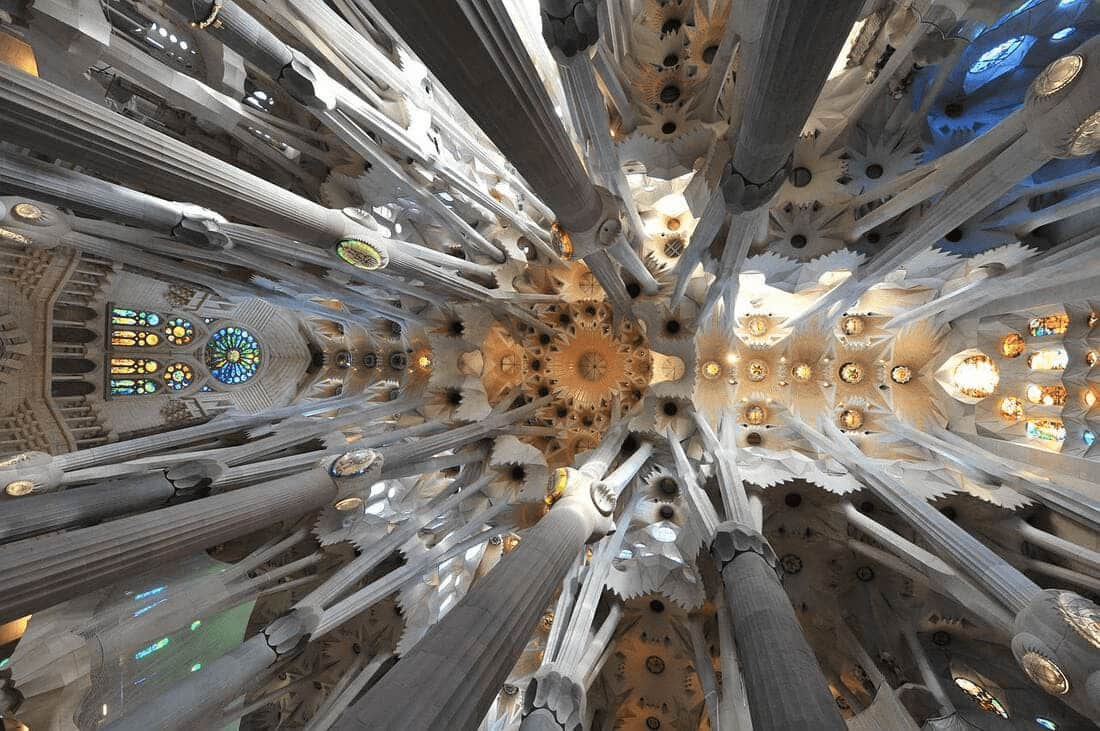
The hyperboloid columns that resemble a fantasy forest
Hyperboloid-shaped columns that resemble tree trunks. They distribute light naturally and create the sensation of being inside a forest within the central nave.
Buy tickets (official provider)
6. Crypt
An underground space where Gaudí is buried. It houses the earliest designs and structures, offering insight into the beginnings of the project as well as Gaudí’s initial architectural solutions.
7. Vegetal details
Decorative elements inspired by leaves, flowers, and branches, found in columns, façades, and sculptures, reflecting Gaudí’s fascination with nature.
8. Domènec Sugrañes
A disciple of Gaudí who continued the construction after his death, overseeing façades and towers during the first half of the 20th century.
9. Helical staircase
Spiral staircases that allow visitors to climb the towers and enjoy views over Barcelona. Their design evokes tree trunks, reflecting the architect’s naturalistic approach.
10. Holy Family sculpture

Main entrance of the Nativity Façade of the Sagrada Família, where biblical scenes related to the birth of Jesus, animals, and vegetal motifs are depicted
It depicts the Virgin Mary, Saint Joseph, and the Child Jesus on the Nativity Façade, combining naturalism with religious symbolism.
11. Evangelists – Towers
Four towers representing the Evangelists: Matthew, Mark, Luke, and John. Each tower is crowned with symbolic figures such as an angel, a lion, a bull, and an eagle, and together they surround the Tower of Jesus Christ, forming a harmonious ensemble.
Skip the Lines at the Sagrada Familia
Get your Sagrada Familia tickets in advance and skip the endless lines at the entrance.
12. Glory Façade
It will be the main façade dedicated to the glorification of Christ, depicting scenes of the Last Judgment and the entrance to Heaven. Still under construction, it will serve as the basilica’s main entrance.
13. Nativity Façade
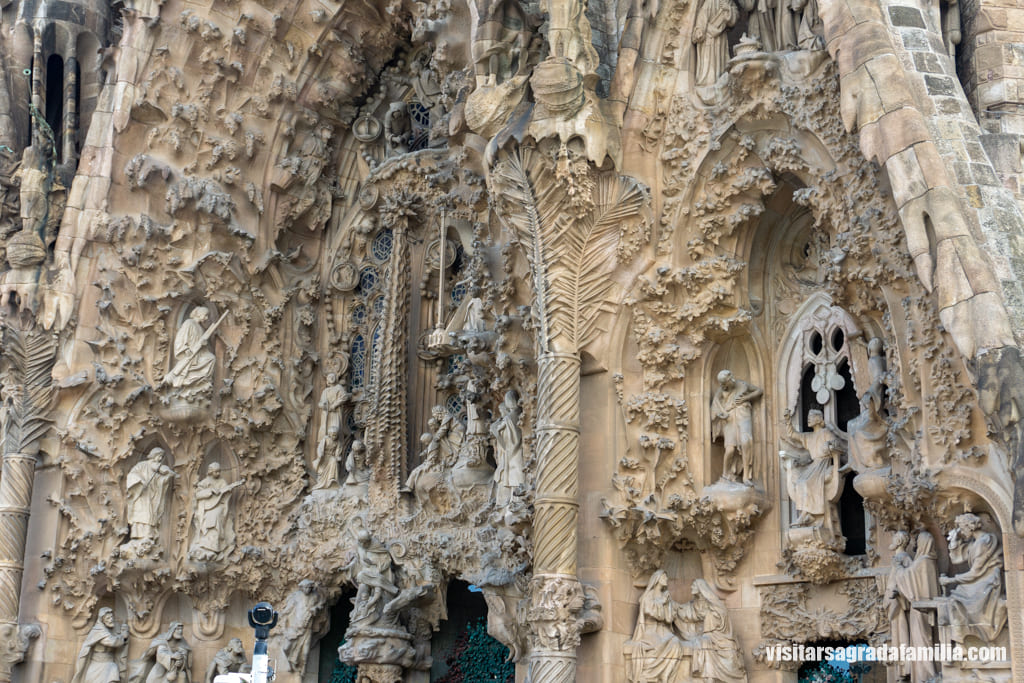
Nativity Façade
Decorated by Etsuro Sotoo, it represents the joy of the birth of Jesus through sculptures of animals, plants, and scenes of everyday life. It is the only façade completed under Gaudí’s direct supervision.
14. Passion Façade
Designed by Josep Maria Subirachs, it depicts the crucifixion of Christ in an angular and dramatic style. The intense facial expressions of the sculptures convey emotion and suffering.
15. Francesc de Paula Villar
The original architect of the Sagrada Família, responsible for the first plans of the Sagrada Família, which Gaudí later reinterpreted and transformed into his unique masterpiece.
16. Sacred geometry
The use of mathematical proportions and geometric figures (such as the Fibonacci spiral), which Gaudí employed to achieve aesthetic harmony and spiritual symbolism.
17. Jesus Christ – Tower
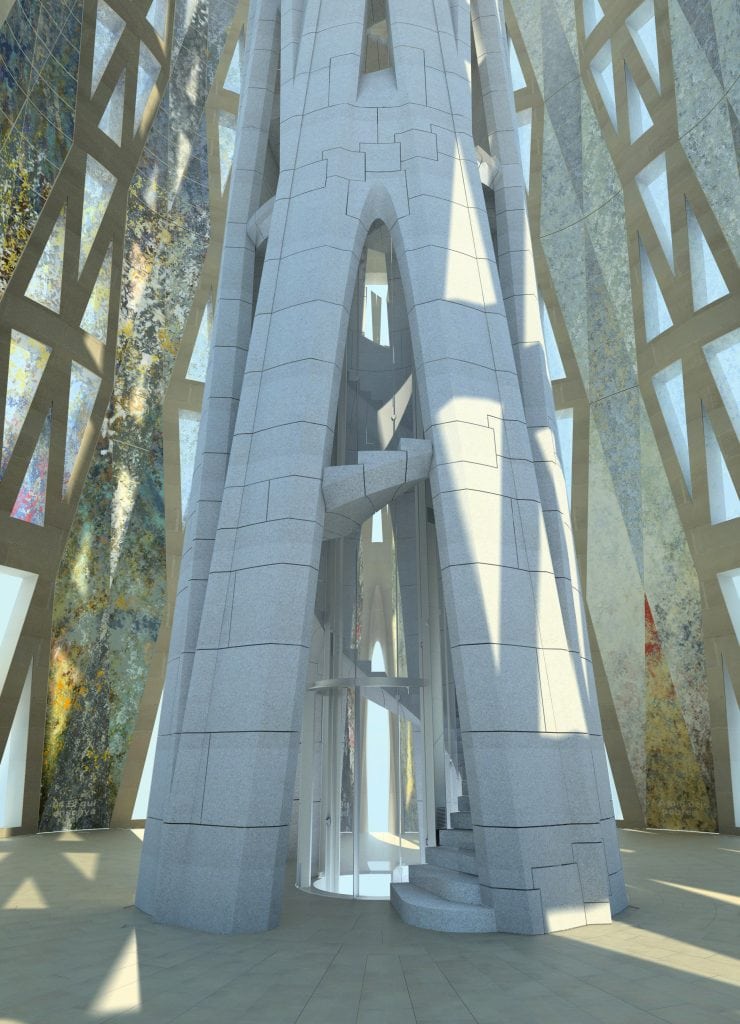
Interior of the Tower of Jesus Christ in the Sagrada Família, Barcelona
It will be the tallest tower of the basilica, standing at 172.5 metres, and is scheduled for completion in 2026, the centenary of Gaudí’s death. It represents the connection between heaven and the city and is visible from many points across Barcelona.
18. Jesuits and other inspirations
In addition to Gaudí, the temple was influenced by religious figures and architects who promoted its construction, such as Father Josep Maria Bocabella and other members of the Association of Devotees of the Sagrada Família.
19. Josep Maria Subirachs
The sculptor who designed the figures of the Passion Façade. His modern, angular style marked a departure from Gaudí’s naturalism and sparked both admiration and controversy at the time.
20. Lluís Bonet
An architect who continued the work after the Spanish Civil War, adapting Gaudí’s plans to modern construction techniques and ensuring the continuity of the project.
21. Central nave
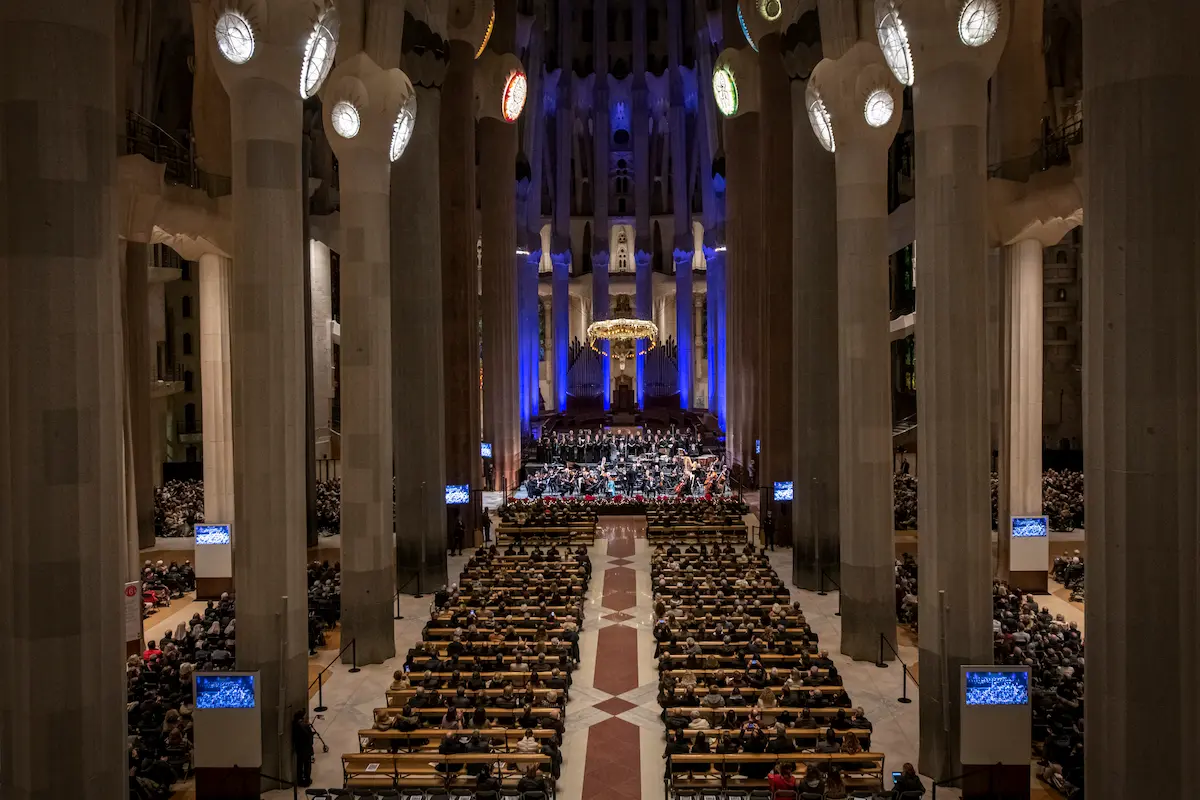
View of the Central Nave during the Christmas Concert at the Sagrada Família
The main space that guides the visitor’s gaze toward the high altar. Its columns and stained glass windows create a sense of verticality and openness, evoking a forest made of stone.
22. Naturalism
A style that integrates natural forms into architecture and sculpture, visible in columns, façades, and ornamental details.
Skip the Lines at the Sagrada Familia
Get your Sagrada Familia tickets in advance and skip the endless lines at the entrance.
23. Organ
The main organ, designed by Gerhard Grenzing, is located in the central nave and fills the basilica with enveloping sound, accompanying ceremonies and concerts with great solemnity.
24. Orange Tree Courtyard
An inner garden with orange trees, conceived by Gaudí as a space for serenity and contemplation before entering the high altar area.
25. Presbytery
The area where the high altar is located, the liturgical heart of the temple, surrounded by light and designed to focus the visitor’s attention on the central religious act.
26. Sacristy
The place where liturgical garments and objects are prepared. Its design combines functionality with ornamental details consistent with Gaudí’s style.
27. Religious symbolism
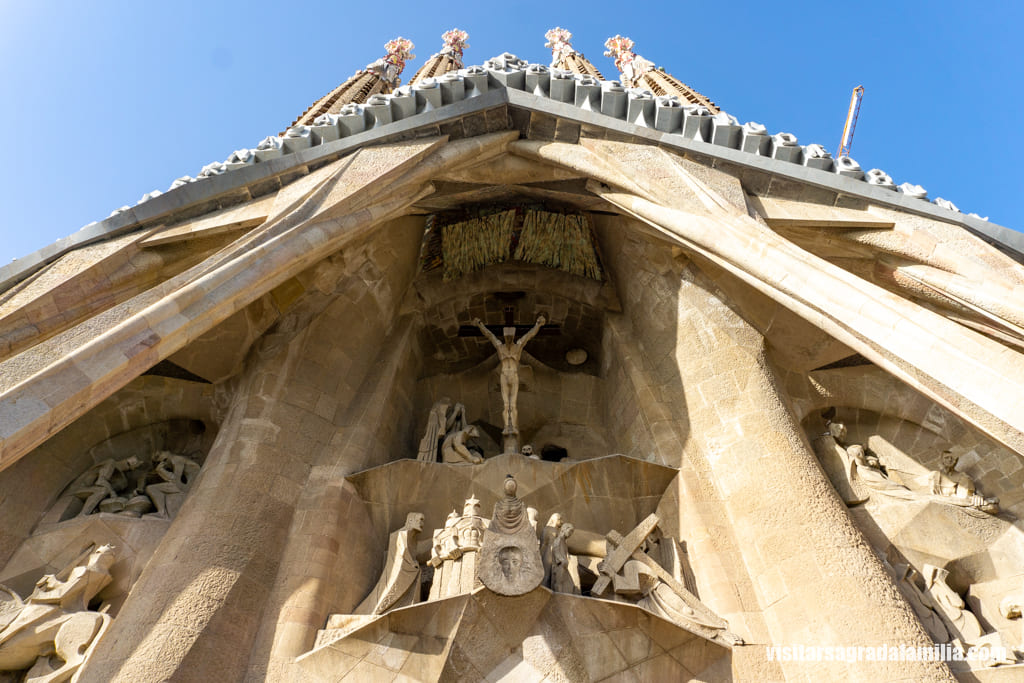
The Passion Façade with four of the Apostles’ towers
Every architectural detail carries meaning: the columns represent apostles, the stained glass windows narrate the Gospels, and divine light illuminates the paths leading toward the altar.
28. Transept
The transverse section that forms a cross with the central nave. It is essential for both the structure and the interior lighting.
29. Trencadís
A Catalan mosaic technique using fragments of ceramic and glass, employed by Gaudí in towers, staircases, and decorative elements.
30. Virgin Mary – Tower
Located in the apse and surrounded by the Towers of the Evangelists, it symbolizes the Virgin Mary’s protection over Barcelona.
31. Stained glass windows
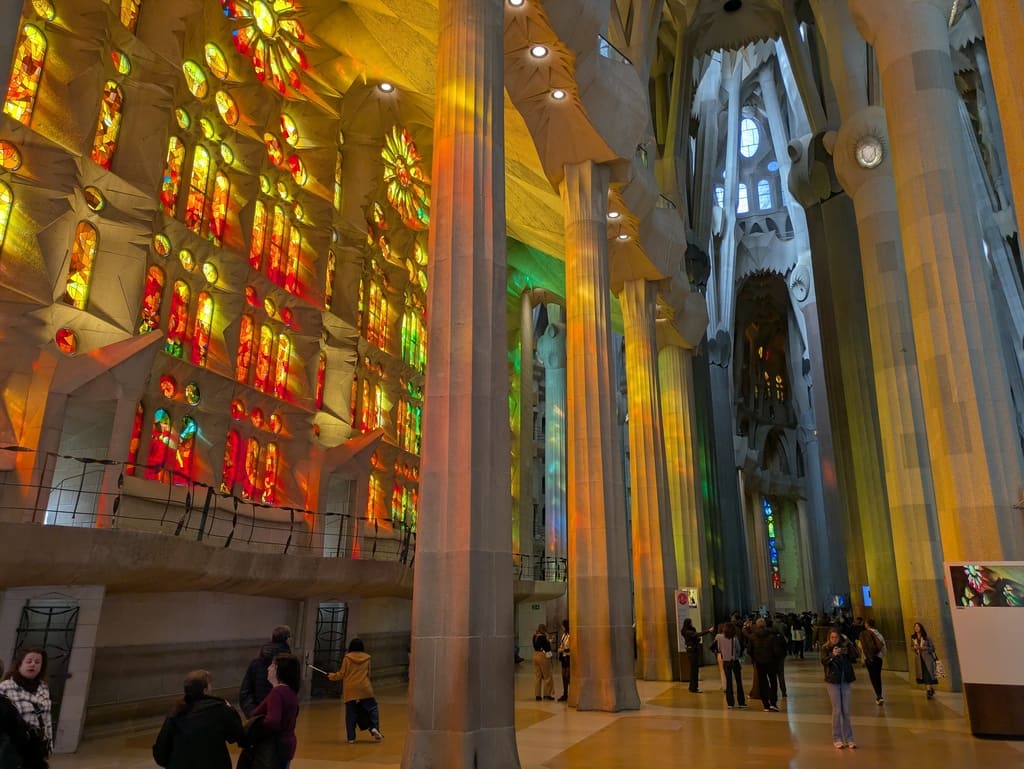
The effect of natural light filtering through the stained glass windows of the Sagrada Família.
Designed by Joan Vila-Grau, the stained glass windows fill the temple with warm and cool light depending on the sun’s orientation. Each colour and shape carries symbolic and aesthetic meaning.
32. Architectural volumes
The forms and masses created by the towers, naves, and façades, generating a unique sense of balance and dynamism throughout the basilica.
Discovering the Sagrada Família means immersing yourself in a world of light, form, and symbolism where nature and architecture come together. Every tower, façade, and detail tells the story of Gaudí and of those who continued his work, creating a living monument that is still growing.
Plan your visit, book your ticket, and if you want to go deeper, join a guided tour and let yourself be amazed by the grandeur and secrets of this one-of-a-kind temple.