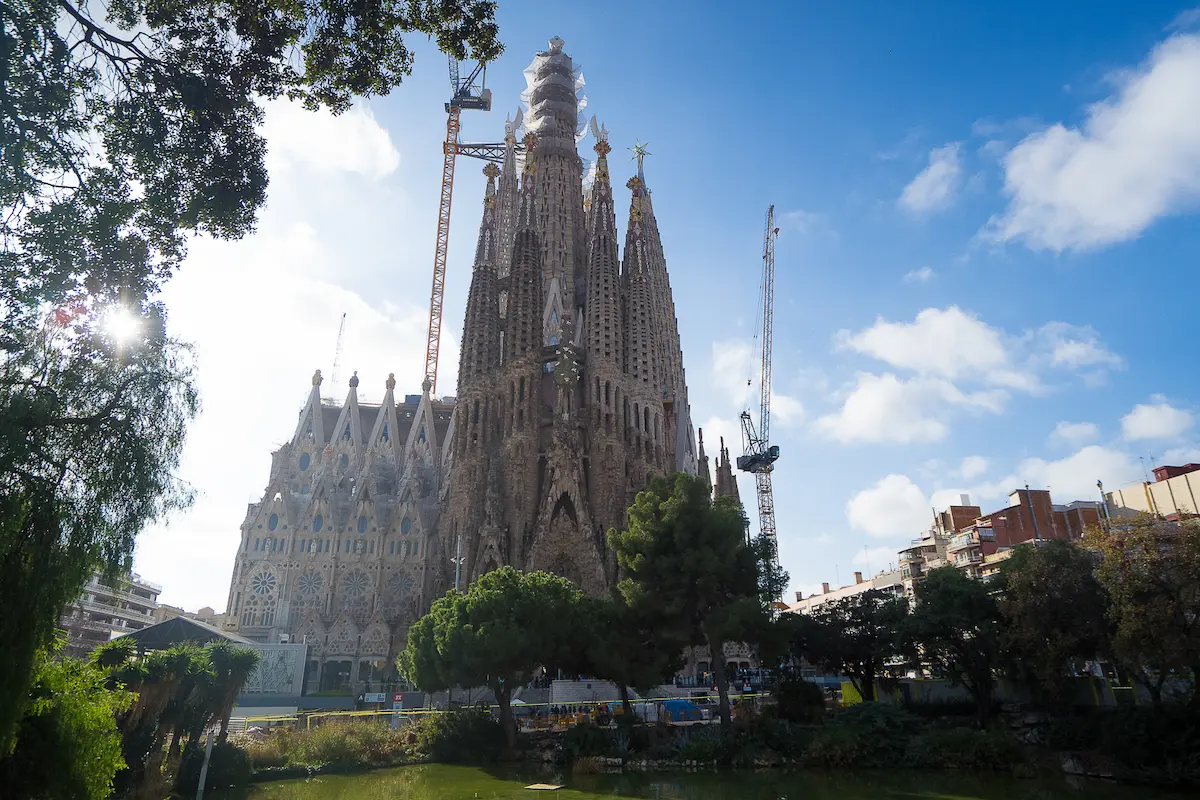
What towers are still missing from the Sagrada Familia? Why is it taking so long to be finished? And most importantly, when will the Sagrada Familia finally be completed? These are some of the questions tourists ask when they visit Barcelona and see the famous cranes surrounding Gaudí’s temple. The construction history dates back to the 19th century, but to this day it remains unclear when we will see it finished. Before the pandemic, 2026 was the expected completion year, but this has changed. In short: the Sagrada Familia will not be finished before 2036. The Tower of Jesus Christ was completed in 2026, but the Glory Facade and its four towers are still to be built.
Book your skip-the-line guided tour
Table of Contents
- When construction started
- What remains to be built
- Why it’s taking so long
- Sagrada Familia’s estimated finish date
When did the construction of the Sagrada Familia begin?
The Basilica of the Sagrada Familia, one of Antoni Gaudí’s undisputed masterpieces and a symbol of Barcelona, began construction in a fascinating historical context. The foundation stone was laid by Bishop José María Urquinaona on March 19, 1882, marking the start of one of the world’s longest and most enigmatic constructions.
At that time, the project was originally led by architect Francisco de Paula del Villar. However, due to creative and financial disagreements, Villar left the project in 1883. That’s when Antoni Gaudí took over, radically transforming the design with his unique vision. Gaudí dedicated over 40 years of his life to the Sagrada Familia, until his death in 1926.
The Sagrada Familia has faced many challenges over the decades, including lack of funding, damage during the Spanish Civil War, and the technical complexities of Gaudí’s visionary design. This project, funded almost entirely by private donations, has continued evolving but always remains true to Gaudí’s designs.
What is still missing from the Sagrada Familia?
The construction of the Sagrada Familia in Barcelona is approaching its final stage, albeit with significant delays. At the time of writing (updated in 2026), 14 of the 18 towers are completed: 8 of the apostles, the 4 of the evangelists, the Virgin Mary’s and Jesus Christ’s. Still missing are the 4 apostle towers of the Glory Facade, whose construction is expected to begin in 2027. At 172.5 meters, the Tower of Jesus is the tallest in the basilica and has made the Sagrada Familia the tallest building in Barcelona (July 2025) and the tallest church in the world (October 2025). Its four-armed cross was completed on February 20, 2026.
The Tower of Jesus Christ was inaugurated on June 10, 2026, the exact centenary of Antoni Gaudí’s death (June 10, 1926). Pope Leo XIV blessed it during his apostolic journey to Spain, from June 6 to 12.
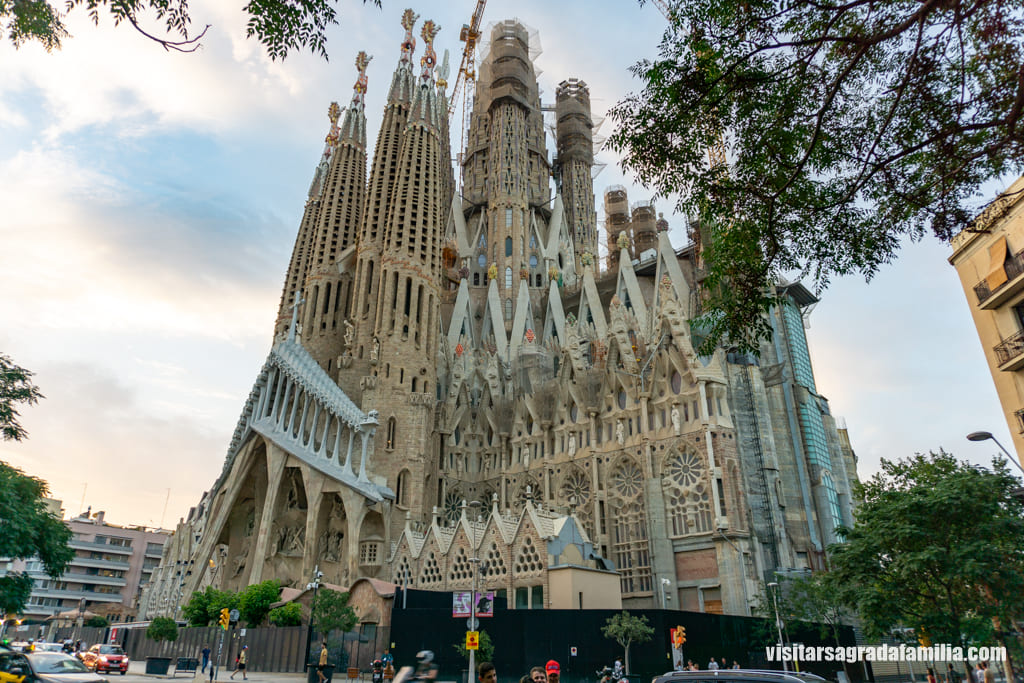
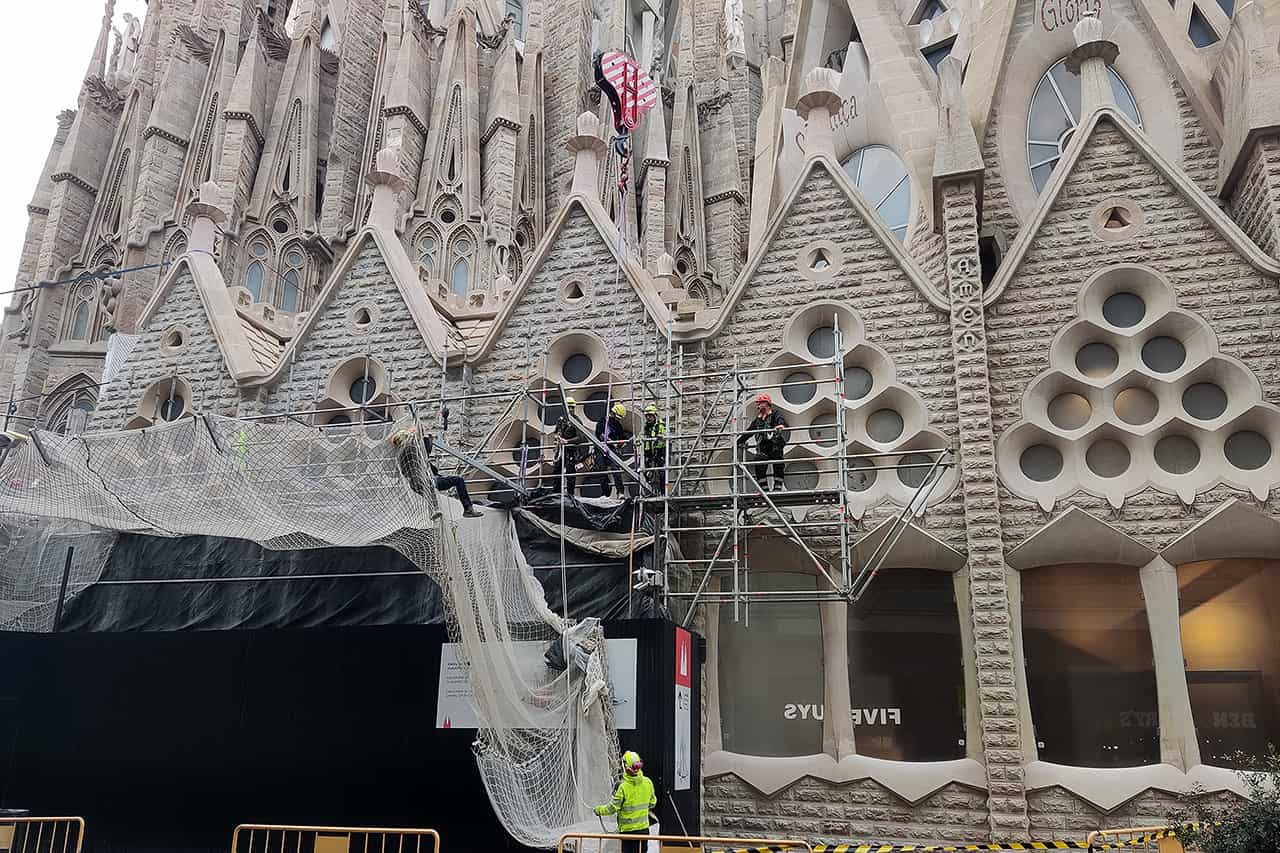
Alongside the towers, several projects are underway in other areas of the temple. Work continues on the Chapel of the Assumption and its cloister, which will be finished in the coming years, on the foundations of the Baptistery, on the roofs of the side naves and on the restoration of the towers of the Nativity Facade, the temple’s oldest section. The Glory Facade, the temple’s main facade, is the major work still pending. It requires a grand staircase over Carrer de Mallorca: negotiations with Barcelona City Council are well advanced, but there is still no agreement (September 2026). The Basilica proposes relocating the affected building.
The Sagrada Familia continues to face logistical and technical challenges. The Sacristy construction will be one of the last parts, as it’s currently used as an entrance and material storage.
Why is the Sagrada Familia taking so long to finish?
Several factors explain the prolonged construction of the Sagrada Familia, making it one of the longest ongoing projects in modern history.
First, Gaudí’s innovative and complex design posed significant technical challenges. The brilliant architect from Reus envisioned a revolutionary design for his time, incorporating intricate structures and shapes that demanded advanced, often experimental, construction techniques. The combination of Gothic and Modernist elements, along with meticulous attention to detail, meant each construction phase was slow and careful.

His sudden death in 1926 was another major setback. By the time he died, only a quarter of the temple had been completed. Constant changes in leadership — with many architects taking over — didn’t help either.
Funding has also been a critical issue. Since its inception, the Sagrada Familia has relied heavily on private donations. This means construction progress has always depended on the availability of funds. Economic crises or periods of low public interest have slowed or even halted the work.
Moreover, 20th-century events also impacted the project. During the Spanish Civil War, parts of the temple were damaged, and original plans and models were lost. Gaudí’s successors had to rebuild and reinterpret his lost designs, adding years to the timeline.

Finally, the COVID-19 pandemic severely impacted construction. Health restrictions and lockdowns forced temporary halts, causing additional delays. The pandemic also affected funding, as the drop in tourism — a major source of income for the Sagrada Familia — reduced available funds. So remember, when you purchase tickets to the Sagrada Familia, you’re contributing to the project.
Sagrada Familia’s estimated finish date
Until recently, the completion of the Sagrada Família was expected in 2026, the centenary of Gaudí’s death. However, the coronavirus pandemic disrupted the plans of the Temple’s Construction Board. The Basilica’s managers estimate, “being optimistic”, about ten years to finish the Glory Facade, which places the end of the works around 2036, more than 150 years after Gaudí took charge of the project.
In any case, the board is not putting pressure on itself (the works could take even longer). With the Tower of Jesus Christ, completed in 2026, the six central towers were finished. The four towers of the Glory Facade remain.
The inauguration of the Tower of Jesus Christ also had an exceptional historical dimension: it was presided over by Pope Leo XIV. During his trip to Spain, from June 6 to 12, he was in Barcelona on June 9 and 10, coinciding with the exact centenary of Gaudí’s death.
On June 10, the Pope prayed at Gaudí’s tomb in the crypt (he is the first pope to do so), celebrated Mass in the basilica and, at the end, blessed the tower from the atrium. It was the first papal visit to Barcelona in 16 years: the previous one was Benedict XVI’s in 2010, when he consecrated the basilica.
The Pope’s visit and the attention the whole world paid to the new tower and to Gaudí’s centenary have given new momentum to the temple to tackle its last major stage: the Glory Facade. Years of work still lie ahead, but the Sagrada Familia is today closer than ever to being finished just as Gaudí imagined it.