The Sagrada Familia, located in the heart of Barcelona, was designed by the famous architect Antoni Gaudí and is one of the masterpieces of Catalan Modernism, despite being unfinished. Today, it is one of the most visited monuments in the country, receiving approximately 4.5 million visitors each year. Want to learn the fascinating history of the Sagrada Familia? Keep reading!
Book your skip-the-line guided tour
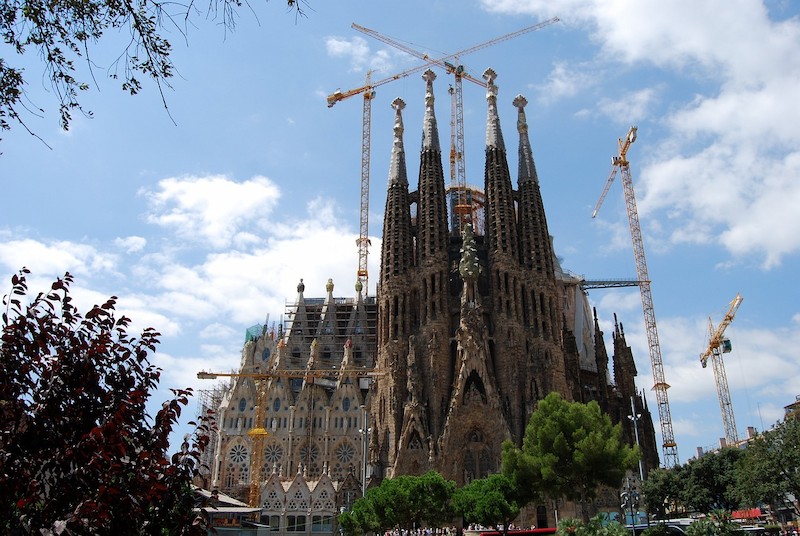
Table of Contents
Beginnings of the Project
The idea of building a church dedicated to the Holy Family emerged around 1866, when a group of Catholics from Barcelona gathered to form an association with the goal of carrying out this ambitious project. The initial plan was to build a neo-Gothic style temple inspired by the Notre Dame Cathedral in Paris. After raising the necessary funds, in 1882, the commission was assigned to architect Francisco de Paula del Villar.
However, after many discussions and disagreements, it was soon decided to change the original design in favor of a more modern style. That same year, the building’s location was chosen on Carrer de Mallorca, and construction of the church began. Although work progressed quickly, construction halted in 1883 due to financial problems—a constant issue throughout the Sagrada Familia’s history.
Fortunately, in 1884 a significant donation from a wealthy Barcelona family allowed construction to resume. From that moment on, the Sagrada Familia became one of the most ambitious and controversial projects in the history of Spanish architecture.
The Incorporation of Antoni Gaudí
In 1883, architect Francisco de Paula del Villar resigned from the Sagrada Familia project due to disagreements with the association’s founder, Josep Maria Bocabella. Bocabella, advised by the renowned architect Joan Martorell, considered him for the leadership. The history of the Sagrada Familia could have been very different, but Martorell declined the offer, and the project was offered to a young architect from Reus named Antoni Gaudí, who was just over 30 at the time.
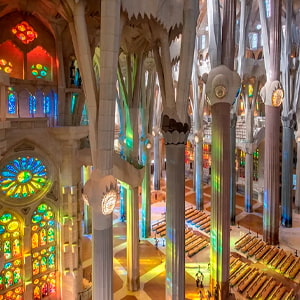
However, Gaudí was already known for his innovative style and interest in organic architecture inspired by nature. His influence on the Sagrada Familia’s design was decisive and can be seen in every detail of the building. During the first years working on the Sagrada Familia, Gaudí balanced this project with other works, but from 1914 onwards, he devoted himself exclusively to building the church.
Gaudí worked on the Sagrada Familia project for more than 40 years, until his death in 1926. During this time, he made numerous changes to the original and subsequent designs, incorporating elements inspired by nature and Catholic symbolism. Some of the most important parts of the temple, such as the crypt, the apse, and the Nativity facade, were completed during his lifetime. However, he did not live to see all the towers he designed for this facade finished, as only one of them—Saint Barnabas’ tower—was completed.
Gaudí’s Successors
Since Antoni Gaudí’s death in 1926, construction of the Sagrada Familia has continued under the direction of various architects. These include Domingo Sugrañes, Francesc Quintana, Isidre Puig i Boada, Lluís Bonet i Garí, Francesc Cardoner, Jordi Bonet i Armengol, and Jordi Faulí i Oller.
Domingo Sugrañes was the first to take on the project after Gaudí’s death. Sugrañes worked on the Sagrada Familia from 1926 to 1936, during the Spanish Civil War period. Despite the difficult times, Sugrañes managed to complete the Nativity facade.
Francesc Quintana took over the works after Domingo Sugrañes’ death in 1938. One of his first tasks was restoring the crypt, which had been damaged during the Civil War, along with the models left by Gaudí to continue the building’s construction. Quintana was also responsible for the Passion facade, which began construction in 1956.
In 1966, Isidre Puig i Boada succeeded Quintana and worked on the Passion facade. Puig i Boada was then succeeded in 1974 by Lluís Bonet i Garí, who continued working primarily on the same facade.
Francesc Cardoner led the works briefly (1983–1985) before Jordi Bonet i Armengol took over. Bonet i Armengol restored the schools’ building and introduced several technological innovations in the construction of the Sagrada Familia.
In 2012, the team led by Jordi Faulí i Oller took charge of the project, possibly writing the final chapters of the Sagrada Familia’s construction. Faulí i Oller completed the Passion facade and is working on the newest towers of the temple.
It was expected that the work would be completed in 2026, coinciding with the centenary of Gaudí’s death. This will not be fully possible, but 2026 will nonetheless be a historic year: on 10 June the Tower of Jesus will be officially inaugurated in a ceremony presided over by Pope Leo XIV, whose apostolic visit to Barcelona will coincide with the centenary of Gaudí’s death. For the total completion of the works, including the Glory façade, the Construction Board points to the year 2033–2035.
Timeline of the Sagrada Familia
The history of the Sagrada Familia is filled with important dates. Some of the most relevant years are:
- 1882: Project begins. Francisco de Paula del Villar y Lozano is chosen as architect.
- 1883: Antoni Gaudí takes over the project after Villar y Lozano resigns.
- 1885: The Chapel of Saint Joseph, located in the crypt, is inaugurated, with the first masses celebrated there.
- 1914: Gaudí dedicates himself exclusively to the Sagrada Familia.
- 1926: Gaudí dies in Barcelona, leaving the project unfinished.
- 1930: All towers of the Nativity facade are completed.
- 1936: The Sagrada Familia suffers significant vandalism during the Spanish Civil War.
- 1976: All towers of the Passion facade are completed.
- 1986: Josep Maria Subirachs creates the sculptural groups of the Passion facade.
- 2018: The cross is placed atop the pediment of the Passion facade, marking its completion.
- 2020: Construction is halted from March to October due to COVID-19.
- 2021: The star is installed on top of the Virgin Mary’s tower, marking its completion.
- 2026: On 10 June, the Tower of Jesus is officially inaugurated in a ceremony presided over by Pope Leo XIV, coinciding with the centenary of Antoni Gaudí’s death. The first papal visit to Barcelona in 15 years.
- 2033–2035: According to the Construction Board, the projected date for the completion of the Glory façade and with it the temple as a whole, although decorative and sculptural works could extend beyond that date.