The Expiatory Temple of the Sagrada Familia is an exceptional and unique masterpiece in the world. A major attraction for visitors to the city of Barcelona who are amazed by Gaudí’s architecture and the spirituality of the site. If you want to learn more about the temple, its uniqueness and architecture, keep reading!
Book your skip-the-line guided tour
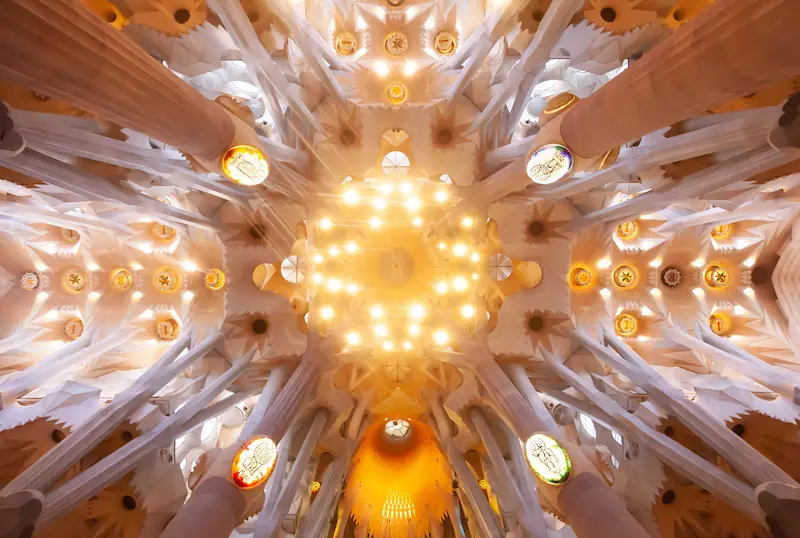
Table of Contents
- The Basilica of the Sagrada Familia
- Facades of the Sagrada Familia
- The Nativity Facade
- The Passion Facade
- The Glory Facade
- The Towers of the Sagrada Familia
- Key Aspects of the Sagrada Familia’s Architecture
The Basilica of the Sagrada Familia
The Basilica of the Sagrada Familia is a work in constant evolution (scheduled to be completed in 2036) that fuses Antoni Gaudí’s creativity with the essence of faith and spirituality. Every detail of this majestic basilica, from its facade to its towers, is imbued with symbolism and meaning, inviting visitors on a journey of beauty and reflection.
The facades, each distinct yet all equally impressive, the cluster of towers reaching for the sky, and the interiors with their forest of columns form an architectural symphony. Although different architects and artists have worked on it, they all follow the great master Gaudí’s baton.
The Basilica of the Sagrada Familia is a living testimony to the union between art and spirituality, technique and devotion — an open invitation for everyone to explore the greatness of faith and marvel at human creativity. It is a must-visit destination for those seeking inspiration, serenity, a deeper connection with the divine, or to experience the pinnacle of art during their visit to Barcelona.
Inside the temple, the main altar is the vibrant heart of the basilica. It is a sacred and sublime space where the Eucharist, the central sacrament of Christianity, is celebrated.
The columns, characteristic of Gaudí’s architecture, resemble trees branching out on the ceiling in whimsical forms. These columns rise with natural elegance, reminding us of the importance of nature and divine creation. Their organic and undulating shapes seem to emerge from the earth itself, full of vitality.
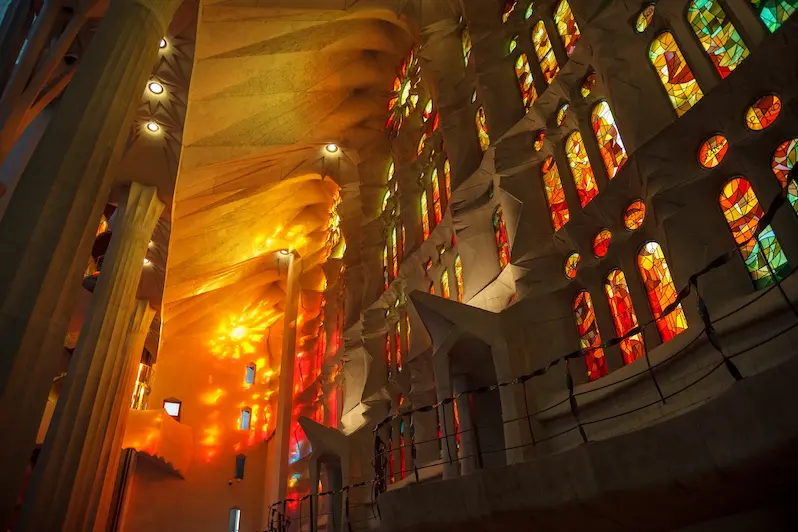
Through the colorful stained glass windows, light softly filters in, creating a unique and ever-changing atmosphere throughout the day. Rays of light scatter in different shades, enveloping the space in a dynamic dance of colors and shadows that magnify Gaudí’s work.
Beneath the floor of the Sagrada Familia lies the crypt, where the mortal remains of its visionary architect, Antoni Gaudí, rest. It is a place of reverence and gratitude towards the creative genius who brought this magnificent work to life.
The Facades: Nativity, Passion, and Glory of Jesus
The Sagrada Familia in Barcelona has three main facades: the Nativity Facade, the Passion Facade, and the Glory Facade of Jesus. Each one is a masterpiece in itself, with its own personality, history, and distinct architectural style.
The Nativity Facade was the first to be built and is undoubtedly the most famous of the three. It was designed by Antoni Gaudí and constructed between 1892 and 1930. Gaudí was determined to build this facade to set a clear design pattern for the temple and to complete a spectacular section to captivate believers — a sort of teaser for the entire project.
This facade is dedicated to the birth of Jesus and features numerous sculptures depicting biblical characters from the Nativity, such as the Three Wise Men, shepherds, and the Holy Family. It is divided into the Portal of Hope, the Portal of Charity, and the Portal of Faith.
The Passion Facade is dramatic and the opposite of the Nativity, expressing the pain and sacrifice of Christ’s passion and death. Gaudí’s design was later complemented by the more modern work of sculptor Josep Maria Subirachs. Built between 1952 and 1978, it features highly realistic and dramatic sculptures depicting scenes such as the Crucifixion, Pilate’s Judgment, and the Last Supper.
The central portal stands out with two massive doors featuring ten thousand raised letters that reproduce fragments of the Passion narrative from the Gospel of Matthew (left door) and the Gospel of John (right door).
The Glory Facade is the most recent of the three and is dedicated to the Glory of Jesus. Created by architect Jordi Bonet and Japanese sculptor Etsuro Sotoo, it was built between 2002 and 2020. This facade features many sculptures and ornamental elements representing the life of Jesus and his ascension to heaven.
The three facades of the Sagrada Familia showcase the genius and creativity of some of history’s greatest architects and sculptors. Each has its own style and personality, but all share the beauty and grandeur that characterize the Sagrada Familia, following the path set by the master Gaudí. Each facade was designed or completed by architects who have left their mark on the Sagrada Família across generations, always guided by Gaudí’s vision.
We may sound repetitive, but visiting this monument is a unique and unforgettable experience no art and architecture lover should miss.
Buy tickets (official provider)
The Towers of the Sagrada Familia
The towers of the Expiatory Temple of the Sagrada Familia are one of the most distinctive features of this iconic monument in Barcelona, visible from all corners of the city.
In total, there are 18 towers planned for the Sagrada Familia, each with a different height and representing the saints and angels that adorn the corresponding facade. At the central axis stands the Tower of Jesus Christ, the tallest of all at an imposing 172.5 metres, symbolising the central figure of Christianity.
Surrounding it rise four towers representing the Evangelists (Matthew, Mark, Luke and John) and one dedicated to the Virgin Mary, which rises majestically reminding us of the central role of the mother of Jesus in the history of redemption. Its construction and subsequent inauguration in December 2021 were moments of great emotion and devotion for visitors, and made headlines across all media in the Catalan capital. The illumination of the star atop the tower of Mary is the crowning achievement of the second tallest tower completed.
Of the six central towers, only the Tower of Jesus remains to be completed, with its inauguration planned for 10 June 2026 in a ceremony to be presided over by Pope Leo XIV. The pontiff’s apostolic visit will also coincide with the centenary of Gaudí’s death, lending the occasion an unprecedented historical and spiritual dimension. The towers of the Glory facade, meanwhile, are still pending construction.
The architecture of the towers is a unique blend of Gothic, Baroque, and Modernist elements. They are made of stone and decorated with numerous ornamental details, such as sculptures, reliefs, and mosaics.
Their construction has been a long and complex process, requiring the work of many architects, engineers, and craftsmen. Most of the towers were built using traditional stone construction techniques, but some of the taller and more recent ones have required advanced techniques, colossal engineering efforts, and the precision of a watchmaker to assemble them at great heights. Watching the progress of the Sagrada Familia’s construction is a spectacle in itself.
Key Aspects of the Sagrada Familia’s Architecture
To fully enjoy and get the most out of your experience visiting the Basilica of the Sagrada Familia, take note of these key elements of Gaudí’s most famous work.
- Christian symbolism: The Basilica of the Sagrada Familia is full of Christian symbolism, from the figures of the apostles and prophets on the pediments to the symbols of Creation in the stained glass windows.
- Nature: Gaudí was inspired by nature to create the basilica’s forms and details, such as the tree-like columns and organic shapes in the decorations. Organic elements can be found wherever you look closely.
- Light: Gaudí used light innovatively to create a spiritual atmosphere in the basilica, with stained glass windows that allow natural light to filter through in various shades and an artificial lighting system.
- Innovation in structural design: Gaudí used new construction and structural design methods, such as compression load techniques and iron framework structures.
- Use of ceramics: Gaudí extensively used ceramics in the decoration of the basilica, creating intricate and colorful details.
- The absence of a specific architectural style: The Basilica of the Sagrada Familia is unique in lacking a specific architectural style, combining Gothic, Modernist, and Neo-Gothic elements.
- Ongoing expansion: The Basilica of the Sagrada Familia is still under construction, with plans to complete it by 2026, marking the centenary of Gaudí’s death.
- The presence of three facades: The Basilica features three facades, each with different themes and symbolism: the Nativity, the Passion, and the Glory.
- Symmetry and proportion: Gaudí used symmetry and proportion in the basilica’s construction, creating a sense of overall balance and harmony in the structure.
- Attention to detail: Gaudí paid great attention to detail in the basilica’s construction, creating an architectural masterpiece that is impressive both in its scale and in its seemingly insignificant details.