Although Antoni Gaudí (1852–1926) is recognized as the leading figure of Catalan Modernism, his work was deeply marked by intense spirituality, especially reflected in the Basilica of the Sagrada Familia, where his architectural genius intertwines with his religious faith in a masterful way.
Understanding the depth of Gaudí’s faith allows for a more profound appreciation of the Sagrada Familia. Keep reading to understand the relationship between Gaudí and religion and how it influenced the creation of this unique temple in the world.
Book your skip-the-line guided tour
Table of contents
- Gaudí’s beginnings and faith
- Gaudí’s spiritual transformation
- The final years and his religious devotion
- The path to beatification
- How Gaudí’s faith enriches the visit
- The Sagrada Familia: faith turned into architecture
Gaudí’s Early Years and His Initial Relationship with Faith
Gaudí was born in Reus in 1852 and spent part of his childhood in Riudoms, in a deeply Catholic family environment.
From a very young age, he showed a reserved character and a tendency to fall ill easily, even suffering from rheumatism as a child, which contributed to developing a particular sensitivity to nature, an element he would later fuse into all styles and phases of his architectural work.
During his education, his contact with the artistic world and the study of architecture coincided with a period in which his religious practice could be described as irregular. After his first steps in architecture, Gaudí did not hide his sympathy for the bourgeoisie and worldly life.
In fact, when he accepted the position to continue the works of the Expiatory Temple of the Sagrada Familia in 1883, his main motivation was not religious; he was aware that this project could cement his professional standing.

At that time, he was already executing the works of Casa Vicens, the first of his most important works in Barcelona, but the Sagrada Familia was his first major project.
However, the religious values and stories learned at home marked a background that would be decisive in his spiritual maturity. The lack of stable commissions during a period and the misunderstanding of some of his projects reinforced his tendency toward introspection and inner exploration.
Gaudí and Religion: Spiritual Evolution
As Gaudí progressed in his career, his faith deepened progressively and remarkably. He faced periods of introspection and personal crisis, which coincided with illnesses and professional challenges.
Gaudí lost several key figures, including his mother, his brother Francesc, and his niece Rosa. These consecutive losses left a profound mark and led him to rethink life, death, and the transcendent meaning of his existence.
Moments of vulnerability like these strengthened his relationship with religion, leading him to an increasingly austere life centered on prayer. He embraced vegetarianism and a preference for prolonged fasts, which began to take on an increasingly religious dimension.
His spiritual evolution intensified in the final years of his life, when he devoted himself entirely to the Sagrada Familia. This absolute dedication reflected not only a professional commitment but also a testament to Gaudí’s spirituality, where architecture and faith are inseparably intertwined.
Final Years of Life and Devotion to Spirituality
In 1916, the death of Josep Torres i Bages, Bishop of Vic and a personal friend of Gaudí, took place, an event that marked the last decade of Gaudí’s life.
Torres i Bages was one of the most influential thinkers of late 19th-century spiritual Catalanism. His work, especially La tradició catalana (1892), defended the idea that Catalan identity was strongly linked to Christian tradition.

Gaudí began practicing a silent and constant devotion. His rhythms of prayer and meditation were part of his daily life, and his personal austerity, reflected in the simplicity of his clothing and appearance, inspired respect among those who knew him.
Father Agustí Mas i Folch was also a figure who strongly influenced Gaudí, especially in his final years. He maintained frequent conversations with him, particularly about the Sagrada Familia and its liturgical symbolism.
He accompanied him during his most austere period, when Gaudí practically lived in the temple workshop. Father Agustí became one of his spiritual confidants, someone with whom Gaudí could discuss doubts, devotional practices, and important decisions.
After Gaudí’s death in 1926, Mas i Folch declared that Gaudí had lived a sincere and constant faith, highlighting his humility and sense of mission.
Contemporary testimonies emphasize his humble character and dedication to work as a form of active prayer. Gaudí’s life combined discipline, creativity, and spirituality, showing that Gaudí’s religion was not merely a cultural accompaniment but a driving force behind his work and existence.
.jpg)


The Beatification Process of Antoni Gaudí
The spiritual dimension of Gaudí has gained particular relevance after his recognition as Venerable by the Catholic Church in 2025, the first step toward his beatification, and it takes on even greater meaning looking ahead to 2026, the year that will mark the centenary of his death and the scheduled inauguration of the Tower of Jesus, the culminating symbol of the spirituality of his work.
Being declared Venerable is the Church’s formal recognition that Gaudí lived a life of heroic virtues. Beatification requires a rigorous process: the investigation of his life and works, verification of miracles attributed to his intercession, and validation of his moral exemplarity.
The Association for the Pro-Beatification of Antoni Gaudí has supported this cause for over 30 years, promoting documentation and testimonies that attest to his faith and testimony.
This process is not only of religious significance but also cultural, as it reinforces the symbolic dimension of the Sagrada Familia and its importance for Barcelona and the large number of people who visit it.
Understanding Gaudí’s Faith Enriches the Visit to the Sagrada Familia
Understanding Gaudí’s spirituality allows one to interpret the Sagrada Familia beyond its architectural grandeur. Every detail, from the arrangement of the columns to the texts inscribed in stone, takes on new meaning when it is understood that it was conceived by a deeply devout man.
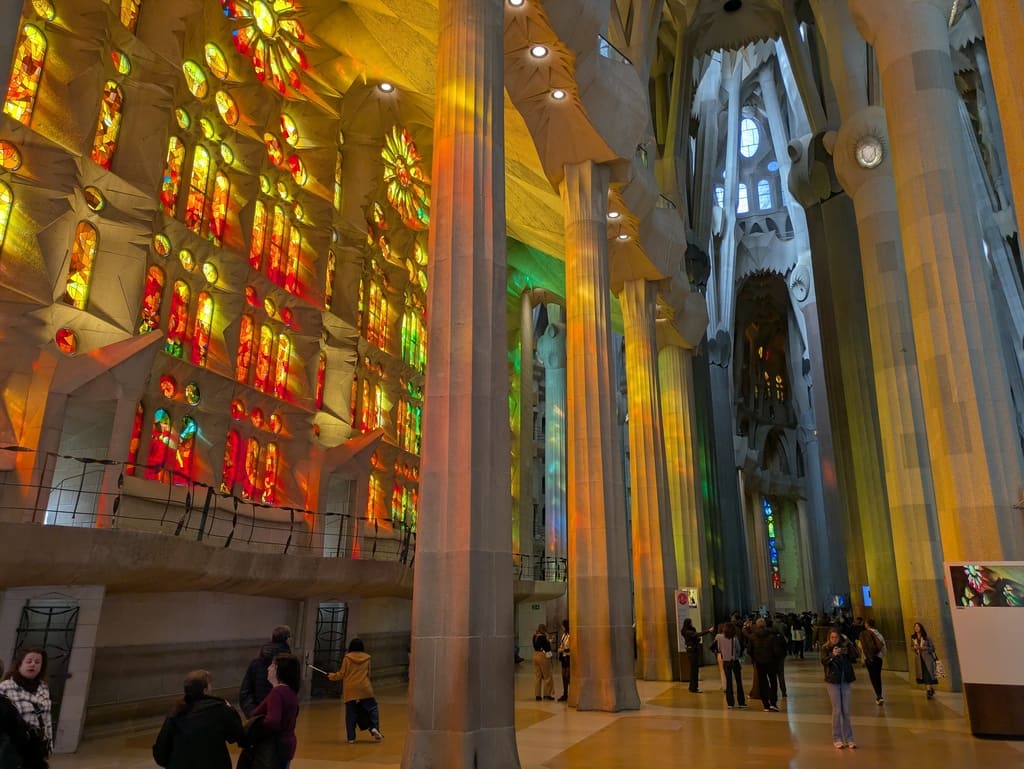
For those visiting the temple, this transforms the experience: one can appreciate how the light, symbols, and spatial organization reflect Gaudí’s religious vision. Places such as Gaudí’s Crypt, where his remains rest, connect directly with his spiritual dimension.
Understanding his faith also adds much more depth to tours and guided visits of the temple, offering a more complete and enriching experience for every visitor.
Gaudí and the Sagrada Familia: Faith Turned into Architecture
The Sagrada Familia is much more than a temple: it is the architectural expression of Gaudí’s faith. Every façade, every sculptural detail, and even the most curious elements carry meaning that reflects his interpretation of Christianity, the Bible, and nature as manifestations of the divine.
During the last decades of his life, Gaudí dedicated entire days to the temple, practically living within the work. His religious vision is also evident in the exterior of the basilica, such as the façades dedicated to the Nativity and the Passion, the integration of liturgical texts, and the future Tower of Jesus, which will reach 172.5 meters and stand as the central spiritual symbol of the temple.
Gaudí’s design combines the theological with the natural: columns that evoke trees, light that symbolizes the divine presence, and organic forms suggesting harmony and transcendence. The Sagrada Familia is, in essence, an architectural catechesis that allows visitors to read the biblical story through stone and space.
To connect with Gaudí’s spiritual and artistic universe, it is essential to explore the interior of the Sagrada Familia and the crypt where his remains rest.
Book your tickets or choose a guided tour that will help you interpret the symbolism and spiritual vision that inspired Gaudí and turned it into a living work that continues to grow and will reach one of its most anticipated milestones in 2026.