The genius of Gaudí can be found in many places beyond the Sagrada Familia, and Park Güell is one of them. It is a must-see stop to discover not only one of Barcelona’s most famous green spaces, but also a setting where architecture and nature come together to offer a truly unique experience.
Would you like to know how to plan your visit, what to see, and how to make the most of your time there? Keep reading and discover everything you need to know about Park Güell.
Book a tour of Park Güell and the Sagrada Familia
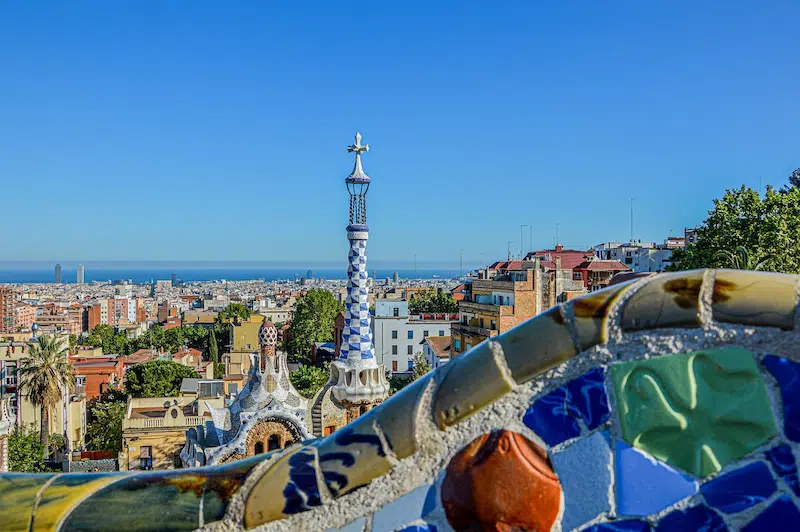
Table of contents
- How Park Güell relates the Sagrada Familia
- Brief history of Park Güell
- What to see in Park Güell
- Tickets, prices, and combined passes
- Park Güell opening hours
- How to get there
- Practical tips for your visit
Park Güell and its relationship with the Sagrada Familia
Park Güell is an essential part of Gaudí’s universe and has a direct connection with Barcelona’s most iconic work: the Sagrada Familia. The basilica, in addition to offering insight into Gaudí’s religious faith, impresses with its height, symbolism, and monumentality, while Park Güell reflects the architect’s more organic, naturalistic, and playful side.
You can enjoy different types of tickets, whether with an audio guide, a guided tour, or by combining both visits in a single day: visiting the Sagrada Familia in the morning and then strolling through Park Güell in the afternoon.

As with the Sagrada Familia, Gaudí’s unmistakable style can be seen in every detail: undulating shapes, colorful mosaics, integration with the landscape, and an approach that combines functionality and art.
Visiting Park Güell means understanding how Gaudí brought his modernist vision into public spaces designed for public enjoyment.
Brief history of Park Güell
Park Güell was conceived between 1900 and 1914 as an innovative garden city project commissioned by Eusebi Güell, an industrialist and patron of Gaudí. The original idea was to create an exclusive residential development with homes surrounded by nature, where art and architecture would blend seamlessly with the environment.
Although the residential project was not completed as originally planned, due to a combination of economic, social, and location-related factors, Gaudí’s vision transformed the space into a public park, preserving its artistic and cultural value.
Eusebi Güell placed his full trust in Gaudí, who developed a design in which every element served both an aesthetic and functional purpose: stairways that guide movement, plazas that make the most of natural light, and landscaped areas that invite walking and contemplation.
Since then, Park Güell has become one of the greatest symbols of Catalan Modernism and one of Gaudí’s most famous works. It is also one of Barcelona’s best viewpoints, offering incredible views of the city and the Mediterranean.
What to see in Park Güell
Park Güell offers many areas for walking and leisure, but if you want to truly understand Gaudí’s genius, you shouldn’t miss these spots within the park:
Dragon Stairway

The iconic Dragon Stairway is one of the park’s busiest and most photographed areas, where a colorful mosaic salamander seems to come to life among curves and stairways. The salamander symbolizes life and regeneration. Gaudí designed it as part of the original fountain and covered it with vibrant “trencadís” mosaics, reflecting his unique style and deep connection with nature.
This emblematic animal not only decorates the entrance but also marks the beginning of a route full of visual surprises.
From here, the stairway leads to the Hypostyle Hall, a covered space with inclined columns and decorated ceilings, showing how Gaudí masterfully fused art and architecture.
Hypostyle Hall

Also known as the “Temple of the 100 Columns” (although there are actually 86), its columns resemble trees supporting an artificial “forest.” In the original project, this hall was intended to serve as a market for the residents of the development.
Some historians interpret that the hall, with its almost temple-like structure, anticipates ideas that Gaudí later developed in the Sagrada Familia: a space that lifts the gaze and inspires awe, almost as a tribute to the harmony of the cosmos.
Skip the Lines at the Sagrada Familia
Get your Sagrada Familia tickets in advance and skip the endless lines at the entrance.
The ceiling and columns also function as a drainage system: the hidden channels and drains reveal Gaudí’s concern for functionality, evoking the way water flows in nature.
Nature Square

This wide esplanade is perfect for resting and taking in Barcelona from above. The undulating benches, decorated with trencadís mosaics, feature serpentine shapes that go beyond mere decoration. They follow ergonomic principles so visitors can sit comfortably in any position and better enjoy the views.
The square was designed with a slight slope that facilitates rainwater drainage, preventing puddles and ensuring the space remains accessible. In addition, its elevated location allows visitors to enjoy panoramic views of Barcelona.
Caretaker’s House and Gaudí House Museum
The Caretaker’s House, located at the park entrance, stands out for its colorful façade and Gaudí’s distinctive style. The Gaudí House Museum offers an additional dimension for delving into the architect’s life and work. Please note that visiting it requires the purchase of a separate ticket.
These are two optional visits, but highly recommended for those curious about Gaudí’s history.
Paths, viewpoints, and forested areas
Beyond the main structures, the park offers winding paths and viewpoints hidden among the vegetation. Walking through these areas allows visitors to discover less crowded corners, ideal for those seeking peace and a closer connection with nature.
Tickets, prices, and combined passes
To access the monumental zone of Park Güell, it is necessary to purchase a Park Güell ticket in advance. This guarantees entry during the selected time slot and helps avoid unnecessary waiting.
There are different ticket options available: general admission, reduced tickets, and tickets for children, as well as combined passes that include other Barcelona attractions.
Popular tickets for Park Güell:
- Park Güell: Ticket + Audio Guide
- Park Güell: Guided Tour
- Combined tour of Park Güell and the Sagrada Familia
Buying in advance is the best way to guarantee your visit and enjoy it without setbacks, as tickets sell out quickly, especially during high season.
Opening hours 2026
Park Güell opening hours vary depending on the season, with earlier opening times in summer and shorter hours in winter.
Seasons and usual opening hours:
- January 1 to February 7 and from October 26/29 to December 31: 9:30 a.m. – 5:30 p.m.
- February 8 to March 29: 9:30 a.m. – 6:00 p.m.
- March 30 to June 30 and from September 1 to October 25/28: 9:30 a.m. – 7:30 p.m.
- July 1 to August 31: 9:00 a.m. – 7:30 p.m.
Important note: the last ticketed entry is usually 30 minutes before the closing time indicated for each season.
Access for residents and special opening hours
The park itself is open from early morning until night, but there are time slots reserved exclusively for residents and members of the “Gaudir Més” program (no tourist access):
- From 7:00 a.m. to 9:30 a.m.
- From tourist closing time until 10:00 p.m.
During these hours, the park remains physically open (natural areas and outer paths), but access to the monumental zone with a visitor ticket is closed until the official tourist time slot begins.
How to get to Park Güell
Park Güell is located in the Gràcia district, north of Barcelona, and can be reached by metro, bus, or on foot from several nearby stations.
Metro
L3 line, Lesseps or Vallcarca station. From Vallcarca, you’ll need to walk uphill along fairly steep streets, so comfortable footwear is recommended.
Bus
Several bus lines stop near the park:
- Bus 24 has a stop very close to one of Park Güell’s entrances. Its route starts in the central Plaça de Catalunya.
- Bus H6 is a good option if you are using metro line 5. It has a stop on Travessera de Dalt, about a 6-minute walk from the park.
On foot
For those who enjoy walking, Park Güell can be reached easily from central Barcelona (although the walk is uphill). To give you an idea: from the Sagrada Familia it’s about 2.5 km (around a 40-minute walk).
Tourist Bus
If you use this service, the blue route has a stop at Park Güell.
By car
Park Güell does not have parking for private vehicles inside the park, and many nearby streets are green or blue parking zones, making it difficult to find a spot. Although public transport is recommended, there are several private car parks around the park if you choose to drive:
- Parking B:SM Travessera de Dalt (Trav. de Dalt, 51, Gràcia, 08024)
- Parking Esperança i Park Güell (Carrer de Sant Cugat del Vallès, 13, Gràcia, 08024).
Location map
Practical tips for your visit

- Best time of day: Early morning or late afternoon to avoid crowds.
- Recommended duration: Between 2 and 3 hours to explore both the monumental area and the paths and viewpoints.
- What to bring: Water, comfortable shoes, a camera or phone for photos, and a cap or hat on sunny days.
- Where to eat nearby: The Gràcia neighborhood offers plenty of tapas bars, cafés, and restaurants to recharge after your visit.
Visiting Gaudí’s Park Güell is more than just walking through a park: it is an immersion into the creativity of an architect who changed the way cities are understood.
Complement your visit with the Sagrada Familia for a complete experience of Gaudí’s universe in Barcelona, and make sure to book your ticket to Park Güell in advance to make the most of your day.