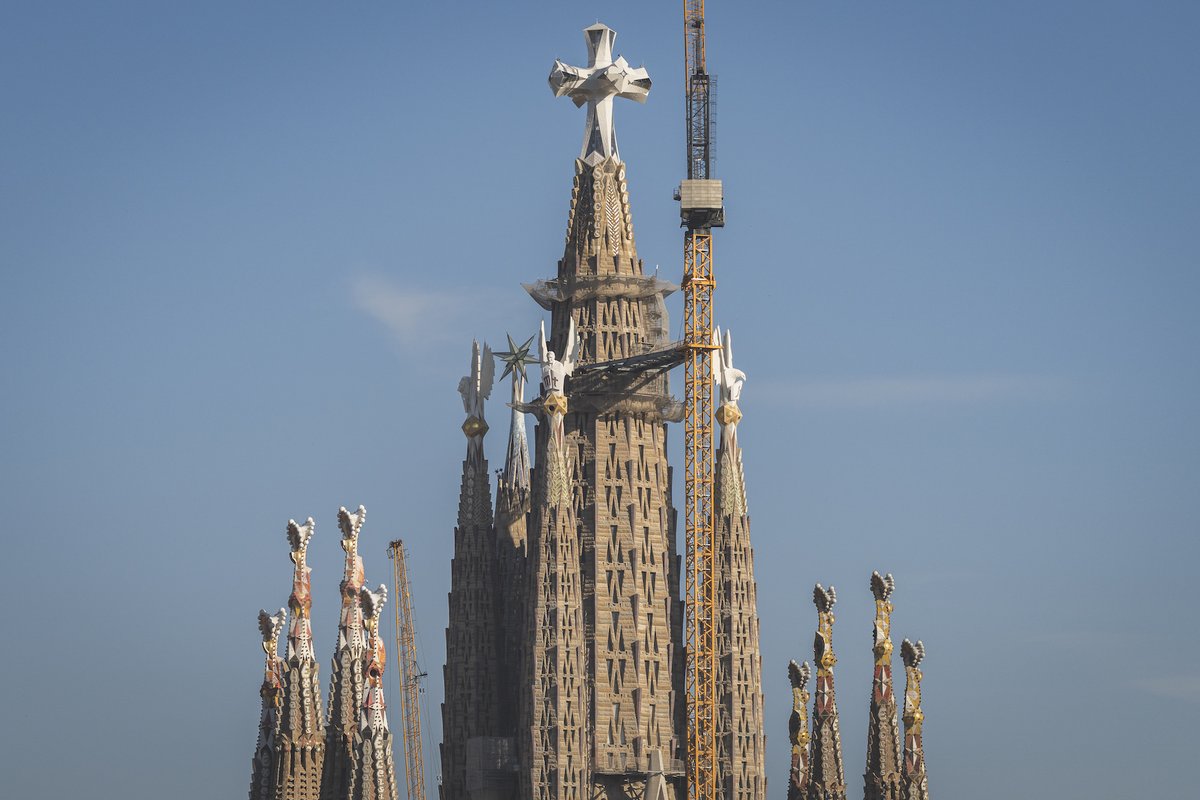
On 20 February 2026, at 172.5 metres above Barcelona, the upper arm of the cross crowning the Tower of Jesus Christ at the Sagrada Familia was put in place. With that moment, the exterior construction of the temple’s central tower was fully completed, and with it, the full set of six central towers designed by Antoni Gaudí. One more step towards the definitive completion of the basilica.
The cross of the Sagrada Familia is Barcelona’s landmark new addition, and in this article you’ll find everything you need to know about it: its dimensions, materials, the Agnus Dei housed inside, the night lighting project, and when the viewing platform will open to visitors.
Book your guided visit without queues
Table of contents
- Dimensions and key technical data
- Design: a Gaudían cross on a monumental scale
- How it was built: manufacturing, transport and assembly
- The materials: ceramic, glass and stainless steel
- The interior: the Agnus Dei and the inscriptions of Christ
- The lighting: it shines by day and illuminates by night
- The viewing platform: when will it open and how?
- The inauguration on 10 June 2026
- How to see the cross from the street
- Frequently asked questions
Dimensions and key technical data
The completion of the Tower of Jesus Christ is no minor milestone. In the Àlbums del Temple Expiatori de la Sagrada Familia of 1927–1929, Gaudí himself wrote: “The great lantern tower will rise, topped at 176 metres by a grand cross with four fluted arms so that the panorama can be contemplated. In the centre will be placed the Divine Lamb.” Nearly a century later, that vision is now a reality visible from across the city.
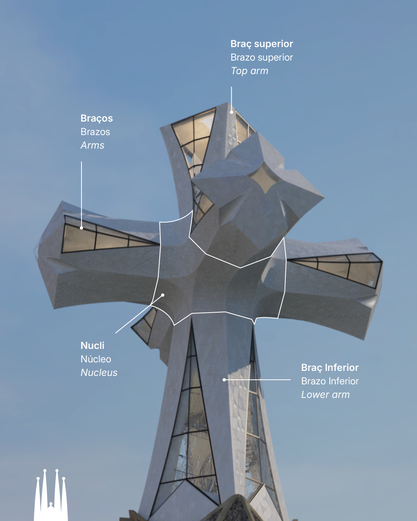
But what makes it most remarkable is that the cross of the Sagrada Familia is not merely a decorative element: it is a three-dimensional structure of monumental scale that will be open to visitors. Here are its main specifications:
| Specification | Value |
|---|---|
| Height of the cross | 17 m |
| Span (lateral arms) | 13.5 m |
| Dimensions of upper arm | 4.5 × 4.5 × 4.9 m |
| Height of complete terminal (base + cross) | 29 m |
| Total weight | ~200 tonnes |
| Interior viewing platform level | 164 m |
| Highest point of the temple | 172.5 m |
To give you a sense of the scale: 17 metres is equivalent to a five- or six-storey building. The 13.5-metre span exceeds the width of most streets in Barcelona’s Eixample district. And all of that, at almost 160 metres above the ground.
The Tower of Jesus Christ is the central tower of the complex, surrounded by the four towers of the Evangelists (each connected to the central tower by a bridge) and by the tower of the Virgin Mary, which connects internally with the Tower of Jesus Christ. It has 12 faces and a total height of 172.5 metres. If you want to explore the full set of 18 towers designed by Gaudí in detail, see our complete guide to the towers of the Sagrada Familia.
The design of the cross: true to Gaudí’s style
The cross is not an invention of contemporary architects: it responds to a typology present in other works by Gaudí. Similar crosses, with that characteristic bell-shaped form (arms that widen towards the tips), can be seen at Casa Batlló, Park Güell and Torre Bellesguard.
It is a three-dimensional cross with four arms, clad in white enamelled glass and ceramic. Its design draws from the study of an original two-armed cross mould by Gaudí preserved in the temple’s heritage collection. The team of architects applied Gaudí’s characteristic double-twist geometry to scale and complete the form, honouring the spirit of the original.
The four arms are oriented towards the four cardinal points of Barcelona, so the cross also serves as a reference for orientation from anywhere in the city.
How it was built: manufacturing, transport and assembly
The construction process of the cross is one of the most fascinating technical stories in the entire Sagrada Familia project. The structure was manufactured in Germany, while the white enamelled ceramic, the interior stone and the glass were produced in various factories and workshops across Catalonia.
The structure arrived from Germany in modules, which were pre-assembled on a working platform 54 metres above the central nave. They were hoisted already assembled in seven pieces: the lower arm, the central core, the four lateral arms, and the upper arm, which was placed on 20 February 2026.
The hoisting sequence was as follows:
- 27 October 2025: Placement of the lower arm. The tower reaches 162.91 metres, becoming the tallest church in the world.
- 20 February 2026: Placement of the upper arm. The tower reaches its definitive height: 172.5 metres.
Materials: ceramic, glass and stainless steel
The choice of materials responds to an objective that Gaudí stated with precision: that the cross should shine by day and give light by night.
The exterior cladding combines two types of white enamelled ceramic pieces: curved pieces and pyramidal pieces, designed to capture and reflect sunlight from different angles. The construction process involves the use of different materials and techniques, with enamelled ceramic and glass specially designed and produced for the cross.
The windows consist of three layers of curved laminated glass, with machined and polished textures and pyramids, which allow natural light to enter the interior without compromising structural integrity. The internal load-bearing structure combines stone and stainless steel.
Inside the cross: the Agnus Dei and the inscriptions of Christ
The interior of the cross is not an empty space. It houses one of the most singular artistic elements in the entire Sagrada Familia: the Agnus Dei.
Andrea Mastrovito, winner of the 2025 international competition, designed the Agnus Dei as a lamb in blown glass and gold leaf within a luminous hyperboloid that alludes to the Trinity and the Eucharist. The sculpture is placed inside the upper arm, visible from within the structure. It includes the inscription from John 1:29: “Behold the Lamb of God, who takes away the sin of the world”, and a beam of light descending from above symbolising the resurrection.
At the base of the tower terminal appear the inscriptions of praise to Jesus Christ “Tu solus Sanctus, tu solus Dominus, tu solus Altissimus” (‘You alone are Holy, You alone are Lord, You alone are the Most High’) written in white enamelled ceramic and brick, and surrounded by palms.
A cross that shines by day and illuminates Barcelona by night
The Endesa Foundation has taken on the artistic lighting of the cross, delivering an efficient design that will save 38% of energy and avoid the emission of 845 kg of CO₂ per year.
The project features 24 beams of light distributed across the arms of the cross, the interior staircase and the Agnus Dei hyperboloid, with symbolic lighting at the tips of the arms and interior lighting along the staircase surface, the landing and the upper arm of the tower.
The lighting concept reflects Gaudí’s philosophy: light emanates from the centre outwards through the windows, the tips and the base.
At night, each arm projects a beam of light visible from across the city. Cardinal Joan Josep Omella summed it up at the signing of the agreement with a phrase that connects directly to the architect’s vision: “For Gaudí, light is the reflection of the divine.”
The viewing platform: when will it open and how?
This is the detail that most interests those planning to visit Barcelona in the coming months: the viewing platform inside the cross will not open to the public until 2027, despite the official inauguration of the tower in June 2026. Interior works will continue through 2027 and 2028.
When it does open, the experience promises to be unique. Access will be via a glass lift to the level of the cross, followed by a final section of spiral staircase to reach the 164-metre mark. The viewing platform is located across the four horizontal arms of the cross, offering 360° panoramic views of Barcelona, with a capacity of just 11 people per visit.
For context: from 164 metres, the views surpass the Torre Glòries viewpoint (125 m) in height. It will be the highest street-level viewpoint in Barcelona.
Prices and visit management have yet to be confirmed by the Junta Constructora. Given the limited capacity of 11 people, tickets will likely be in very high demand from day one. In the meantime, you can book your visit to the basilica and the currently available towers through our guide to Sagrada Familia tickets.
Book your Sagrada Familia ticket with tower access
The inauguration on 10 June 2026
The official inauguration of the Tower of Jesus Christ is scheduled for 10 June 2026, coinciding with the centenary of Antoni Gaudí’s death. The ceremony will be presided over by Pope Leo XIV during his apostolic visit to Spain, the first papal visit to Barcelona in 15 years.
The inauguration will be the opportunity to officially present the tower complex to the world. The date is no coincidence: on 10 June 1926, Gaudí died after being struck by a tram in Barcelona, having never seen even 25% of his life’s work completed. One hundred years later, the tower he conceived as the crowning element of the temple reaches its definitive height.
The event forms part of the Gaudí Year 2026 programme, which includes exhibitions, cultural events and the opening of new spaces within the temple throughout the year. You can find all the details in our article on the Sagrada Familia in 2026: the year of Gaudí’s centenary.
How to see the cross from the street
While the viewing platform remains closed to the public, there are several ways to enjoy the cross from the outside.
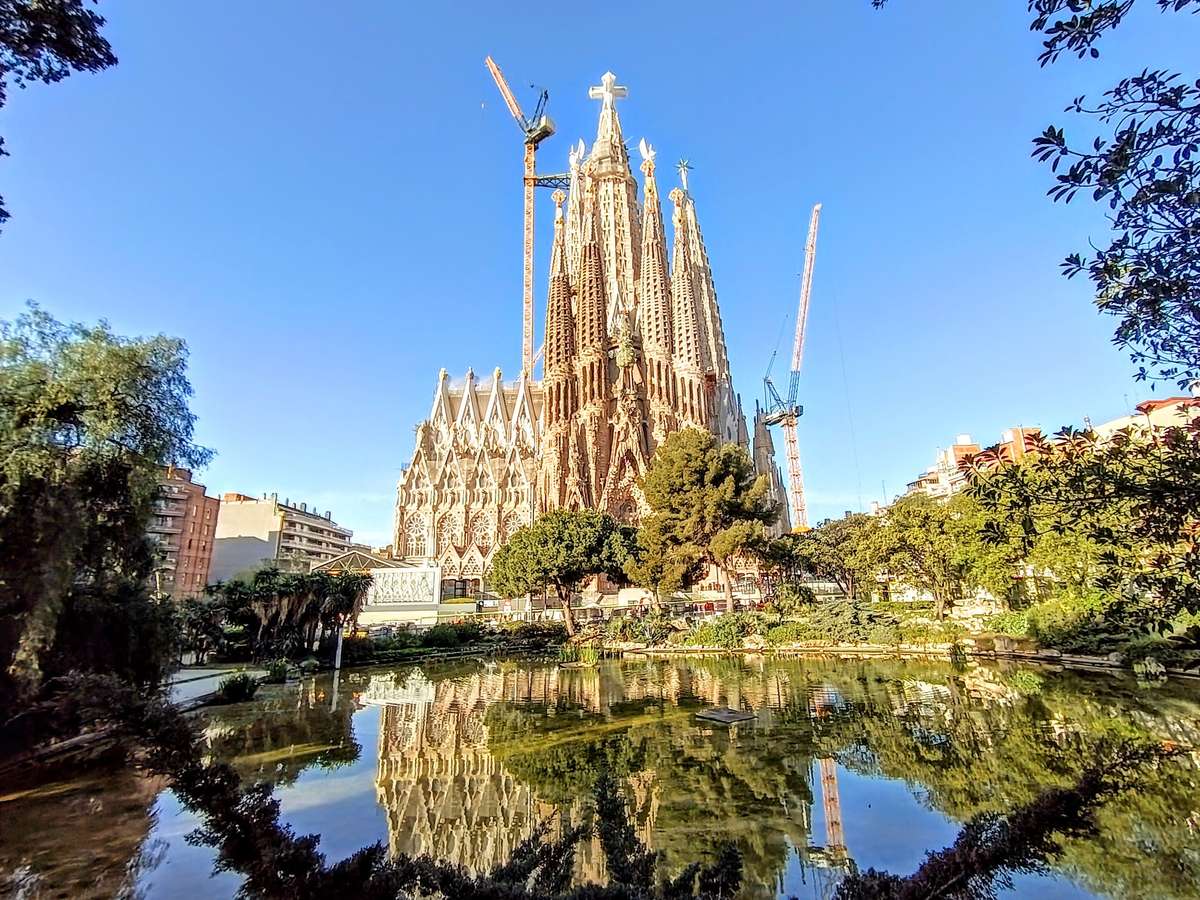
- From Plaça Gaudí (in front of the pond): the most photogenic perspective of the exterior, with the temple’s reflection in the water. The early morning light illuminates the Nativity Façade and the base of the towers directly.
- From Passeig de Gràcia: the towers are visible from several points along this avenue, especially from the junction with Carrer d’Aragó.
- From Park Güell: on a clear day, the Sagrada Familia and the cross of the Tower of Jesus Christ are perfectly visible from the park’s main terrace.
- From Tibidabo or Montjuïc: for an overall perspective of Barcelona with the tower as the city’s highest vertical landmark.
- At night: with the Endesa Foundation lighting active, the 24 beams of light from the cross are visible from points far from the city centre. It is particularly striking from elevated viewpoints such as the Bunkers del Carmel.
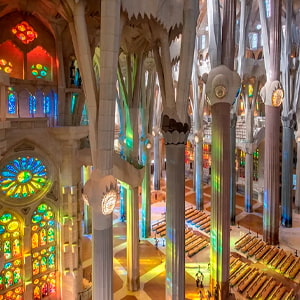
- From inside the basilica: the best way to appreciate the scale of the tower is to see it from within. The stained-glass windows and the central nave offer unique perspectives towards the central towers.
Buy your ticket to see the Sagrada Familia from inside
Frequently asked questions
When will it be possible to visit the interior of the cross of the Sagrada Familia?
The interior viewing platform of the cross will not open to the public until 2027. The official inauguration of the tower is scheduled for 10 June 2026, but interior works will continue through 2027 and 2028.
How many people can the viewing platform of the cross hold?
The viewing platform has a capacity of 11 people per visit, making it one of the most exclusive and highest-demand spaces the Sagrada Familia will have.
How tall is the cross of the Tower of Jesus Christ?
The cross is 17 metres tall and has a span of 13.5 metres. The complete terminal (base plus cross) measures 29 metres. The highest point of the temple, at the tip of the upper arm, stands at 172.5 metres above ground level.
What is the Agnus Dei of the Sagrada Familia?
It is a sculpture by Italian artist Andrea Mastrovito, winner of an international competition held in 2025. It depicts the Lamb of God, made from blown glass and gold leaf, suspended within a luminous hyperboloid inside the upper arm of the cross. It is the materialisation of an original wish expressed by Gaudí in his Temple Albums.
What is the highest point of the Sagrada Familia?
The highest point is the tip of the upper arm of the cross of the Tower of Jesus Christ, at 172.5 metres. This makes the Sagrada Familia the tallest church in the world, surpassing Ulm Cathedral (Germany), which had held that record since the 19th century.
When was the Tower of Jesus Christ inaugurated?
The official inauguration is scheduled for 10 June 2026, presided over by Pope Leo XIV, coinciding with the centenary of Antoni Gaudí’s death. The exterior structure was completed on 20 February 2026 with the placement of the upper arm of the cross.
Why does the cross shine at night?
The Endesa Foundation has developed an artistic lighting project with 24 beams of light distributed across the arms of the cross, the interior staircase and the Agnus Dei hyperboloid. The system is designed so that the cross is visible from across the city at night, with an energy saving of 38% compared to conventional systems.